Contact radioamateur du 06/04/2021

Un contact Radioamateur aura lieu le Mardi 06/04/21 vers 11H27 UTC (13H27 heure de Paris).
Il aura lieu entre Shannon WALKER (KD5DXB) et la School of Information Technology & Mathematical Sciences, Mawson Lakes, SA, Australie.


Le contact aura lieu en télébridge sur 145.800 MHz (+/-3 KHz de doppler) en FM étroite.
Il sera conduit par une station Italienne (IK1SLD) et donc sera audible depuis la France.


Le contact sera conduit en Anglais.


Voici les questions:


1. Aazeen: What do you do to entertain yourself in such a small space for a long time with so few people?
2. Anikesh: Do you have travel sickness or feel suffocated while you are in there?
3. Antony: How do you protect against radiation on the ISS?
4. Rashmi: Have you seen any suspicious activity (like extraterrestrial creatures)?
5. Venuki: Are there any health risks when you are in outer space?
6. Zachary: How long do you think that it would take to discover another universe?
7. Inika: Does space debris affect the ISS?
8. Eugene: When Is space radiation more harmful to astronauts?
9. Jesse: Is the possibility of a fire on the ISS more terrifying when you are on the ISS or when you are training and preparing to be on the ISS.
10. Krishna: How long can the present International Space Station (ISS) be used for?
11. Omar: What are the benefits of exercising in space?
12. Otis: What is your workout routine?
13. Anika: How does it smell in there?
14. Aazeen: What does it feels like in microgravity, especially when brushing teeth or hair or even having a shower?
15. Rashmi: What inspired you to be an Astronaut?
16. Venuki: Can you tell us some more information about the ISS?
17. Zachary: Does warp speed exist?
18. Inika: What simple tasks on Earth requires the most work in space – and what, other than floating, can be done easily in space but is difficult on Earth.
19. Krishna: While in the ISS if someone gets sick, will normal earth medicine work in micro gravity?
20. Aazeen: Have you done any Covid-19 related research on ISS?
21. Krishna: Can we see the far side of the Moon from ISS? Or will we be able to see it from the new planned station orbiting near the moon?
22. Omar: How do you get rid of the smell in the space station?
23. Omar: How serious is the problem of space debris and what is being done about it?

Bonne écoute 🙂

Share Button

Contact radioamateur du 22/03/2021

Un contact Radioamateur aura lieu le Lundi 22/03/21 vers 18H27 UTC (19H27 heure de Paris).
Il aura lieu entre Shannon WALKER (KD5DXB) et le Oakwood School, Morgan Hill, CA, USA.


Le contact aura lieu en télébridge sur 145.800 MHz (+/-3 KHz de doppler) en FM étroite.
Il sera conduit par une station Italienne (IK1SLD) et donc sera audible depuis la France.


Le contact sera conduit en Anglais.


Voici les questions :

1. Marcus (Grade 2): What is your favorite place on the ISS?

2. Remy (Grade 3): Are you currently conducting any experiments yourself?

3. Lauren (Grade 8): What was your favorite part of Astronaut training?

4. Daniel (Kindergarten): What advice do you have for a 6-year-old that wants to be an astronaut?

5. Andrew (Grade 5): What is the hardest thing you have had to do in space?

6. Alice (Grade 1): Is the coronavirus on the ISS and do you need to wear masks?

7. Henry M. (Grade 5): Do you and your crewmates play games in space?

8. Benno (Grade 4): Can you still do your favorite Earth hobbies on the ISS?

9. Cate (Grade 8): Are your astronaut outfits customizable (like can you make them different colors)?

10. Thomas (Grade 12): What happens if there is a medical emergency on the ISS?

11. Ishan (Grade 7): Who was your role model growing up and how have they helped you succeed in becoming an astronaut?

12. Addelyn (Grade 3): How do you communicate with all the astronauts that come from different countries?

13. Aiden (Preschool): Who is your favorite Avenger/superhero and why?

14. Noelle (Grade 6): What is the object you miss the most that is on planet Earth?

15. Miriam (Grade 4): What was the hardest part of the training, and did you think you were going to pass?

16. Anaya (Grade 12): Do the constellations from the space station look different from how they do on Earth?

17. Charlotte (Grade 1): We’ve noticed you use a lot of towels– what if you run out of towels?

18. Luke (Grade 7): Although zero-gravity sounds fun at first, does it get “old” after a while?

19. Annabelle (Grade 4): If you were given the chance, would you like to be the first person to mars?

20. Arjun (Grade 9): How do you stay connected with your family on Earth while in space and how long do you get to talk or see them?

Bonne écoute 🙂

Share Button

Contact radioamateur du 09/02/2021

Un contact Radioamateur aura lieu le Mardi 09/02/21 vers 14H44 UTC (15H44 heure de Paris).
Il aura lieu entre Shannon WALKER (KD5DXB) et le Sterling MS, Ashburn, VA, USA.


Le contact aura lieu en télébridge (multipoint) sur 145.800 MHz (+/-3 KHz de doppler) en FM étroite.
Il sera conduit par une station Belge (ON4ISS) et donc sera audible depuis la France.


Le contact sera conduit en Anglais.


Voici les questions :

1. Valentina (grade 6): What kind of training do you have to complete to become an astronaut?

2. Geovanny (grade 3): How do astronauts stay healthy in space?

3. Ariana (grade 4): What made you want to become an astronaut?

4. Aiden (grade 7): What is your daily routine like?

5. Muqadas (grade 8): Do the sun, stars, sunrises and sunsets look different from the ISS compared to Earth?

6. Ryan (kindergarten): How does your “ship” get you back down to Earth?

7. Isabella (grade 5): What is the weirdest thing that has happened to you in space?

8. Annabelle (grade 6): How do you feel emotionally and physically while in the rocket on your way to the ISS and on your way back?

9. Kaylee (grade 7): What was your reaction when you found out you were chosen to go to the ISS?

10. Mariam (grade 8): When you return to Earth, how long does it take for you to be able to walk again? Do you experience any other side effects of being in zero gravity for extended time?

11. Geovanny (grade 3): asking for Dylan (grade 4) How do you eat and drink in space without spilling and damaging your equipment?

12. Ariana (grade 4) What do you like to do for fun in space?

13. Muqadas (grade 8) asking for Lilyana (grade 8): Are you able to bring your phones and other personal items with you to the ISS?

14. Aiden (grade 7) asking for Omar (grade 7): When you come back to Earth, what will be your first meal?

15. Valentina (grade 6) asking for Julia (grade 6): What do astronauts do if you fall sick in space?

16. Kaylee (grade 7) asking for Amaya: How does it feel to be inside the ISS all the time? Does the environment (temperature, humidity) inside the iSS fluctuate?

17. Mariam (grade 8) asking for Ashley (grade 8): If you weren’t an astronaut, what job would you have?

18. Anabelle (grade 6) asking for Zayn (grade 6): How does it feel to experience 16 sunrises and 16 sunsets every day?

19. Ryan (kindergarten) asking for George (grade 5): How do you train to be in low gravity places?

20. Isabella (grade 5): What do you eat while in space? What is your favorite food?

Bonne écoute 😀

Share Button

Contact radioamateur du 28/01/2021

Un contact Radioamateur aura lieu le Jeudi 28/01/21 vers 17H46 UTC (18H46 heure de Paris).
Il aura lieu entre Mike Hopkins (KF5LJG) et le Newcastle High School, Newcastle, WY, USA.


Le contact aura lieu en télébridge sur 145.800 MHz (+/-3 KHz de doppler) en FM étroite.
Il sera conduit par une station Belge (ON4ISS) et donc sera audible depuis la France.


Le contact sera conduit en Anglais.


Voici les questions :

1.Trinity (10th grade): How long did it take you to fully adjust to being on the ISS?

2.Travis (11th grade): What effects have you experienced from zero gravity?

3.James (12th grade): What do you folks do for fun? Boardgames? Play catch in space?

4.Gunner (12th grade): What is the most interesting thing you have seen on a spacewalk?

5.Grayson (12th grade): What happens when you fly into the South Atlantic Anomaly?

6. Toby (11th grade): What is the most important lesson you’ve learned from your time in space?

7. Nate (9th grade): What types of organisms do you grow or use in space?

8. Trinity (10th grade): I am asking a question for our 2nd grade class. How big is the International Space Station and what is inside? Are there bedrooms, gym, kitchen?

9.Travis (11th grade): Is it weird not being able to experience night and day the same as you would on earth?

10. James (12th grade): What research is currently being conducted? Is it biological?

11.Gunner (12th grade): Have you ever lost something on a spacewalk?

12. Grayson (12th grade): Since Spaceflight-Associated Neuro-ocular Syndrome can affect mission success, does the research currently being conducted on the retina of mice take priority over other experiments?

13. Toby (11th grade): What is the weirdest solution to a problem that you have tried that actually worked?

14. Nate (9th grade): What is the most dangerous aspect about living and working in space?

15.Trinity (10th grade): What is the most exciting thing you have experienced so far?

Bonne écoute !

Share Button

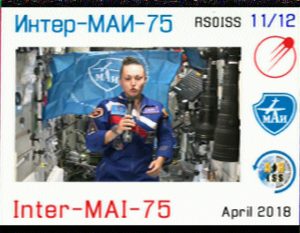
MAI-SSTV experiment 28 & 29 janvier 2021

L’Institut d’aviation de Moscou exploitera le SSTV pour quelques passes qui survolent Moscou les 28 et 29 janvier. Il est prévu que le mode PD-120 sera utilisé sur la fréquence 145.800 MHz.

Les horaires de l’expérience sont actuellement prévus comme suit :

  • 28 janvier – Début des transmissions à 12:10 UTC et arrêt des transmissions à 17:15 UTC
  • 29 janvier – Début des transmissions à 13h10 UTC et arrêt des transmissions à 18h05 UTC

Consultez l’article sur la réception des images SSTV

Recevoir la SSTV avec l’ISS | AMSAT Francophone (amsat-f.org)


Source : ARISS-SSTV images (ariss-sstv.blogspot.com)


Share Button

Contact radioamateur du 21/01/2021

Un contact Radioamateur aura lieu le Jeudi 21/01/21 vers 18H27 UTC (19H27 heure de Paris).
Il aura lieu entre Mike Hopkins (KF5LJG) et le Maine Regional School Unit 21, Kennebunk, ME, USA.


Le contact aura lieu en télébridge sur 145.800 MHz (+/-3 KHz de doppler) en FM étroite.
Il sera conduit par une station Italienne (IK1SLD) et donc sera audible depuis la France.


Le contact sera conduit en Anglais.


Voici les questions :

1. Evelyn (11): How do you communicate with your family at home?

2. Torben (10): What do you miss the most from home?

3. Mia (10): How did you feel when you looked back and saw earth for the first time?

4. Rory (10): What are your favorite scientific experiments on the ISS right now?

5. Elise (8): Do magnets behave the same way in space as they do on Earth?

6. Tyler (10): What is the most dangerous part of being in space?

7. Ruby (9): What does it smell like in the space station?

8. Jack (10): How do you stay in shape on the ISS?

9. Scotia (10): What happens if someone gets hurt in space?

10. Oliver (9): How long and hard did you train to be an astronaut?

11. Evelyn (11): What are the side effects of being in space?

12. Torben (10): How do you conquer your fear in space?

13. Mia (10): What does a day in an astronaut’s life look like?

14. Rory (10): Have you seen any super rare and awesome things in space?

15. Elise (8): Do stars look closer when you’re in space?

16. Tyler (10): What’s your favorite part of being an astronaut?

17. Ruby (9): Does the food you eat taste different than it does on earth?

18. Jack (10): Do you think we are the only intelligent life forms in the universe?

19. Scotia (10): What classes in school helped you the most as an astronaut?

20.Oliver (9): What surprised you most about being in space or on the ISS?


Il est à noter qu’un espace est prévu pour vos commentaires et rapports d’écoute sur le forum de l’AMSAT francophone : ici
Bonne écoute 

Share Button

MISSION X 2021 est lancée

Les astronautes ont besoin de plusieurs années d’entrainement et de préparation avant leurs missions dans l’espace. Avec Mission X, les élèves apprennent les gestes clés pour rester en forme et en bonne santé, sur Terre comme dans l’espace.

Mission X est un projet d’éducation à la santé, thème abordé dans le programme du cycle 3. Il offre une approche ludique de la lutte contre la sédentarité et l’obésité en s’appuyant sur la thématique spatiale. Continuer la lecture

Share Button

SSTV – 20 ans ARISS – Comment recevoir des diplômes

(Image reçue via Station Satnogs (SatNOGS Network – Ground Station XTOPHE) +décodage MMSSTV) 


A l’occasion des transmissions SSTV, il est possible d’obtenir des diplômes validant la réception des images SSTV transmises à partir de l’ISS.

Au traditionnel diplôme d’ARISS (Pologne)  et de l’AMSAT Argentine,  cette fois ci il est possible de recevoir un diplôme de Russie et d’Indonésie.

Pour commencer, il est possible de publier les images reçus sur le site ARISS SSTV Image Submission (spaceflightsoftware.com) 

Ceci est un prérequis pour au moins le diplôme ARISS (Pologne).


Diplôme ARISS  (Pologne)

SiteARISS SSTV Award (pzk.org.pl)

Date limite pour envoyer la demande :  3 janvier 2021 à 23h59 UTC

Diplôme envoyé par mail au format PNG

Mode opératoire 

  1. Chargez vos images décodées sur la page : www.spaceflightsoftware.com/ARISS_SSTV/submit.php (Si vous l’avez déjà fait, vous n’avez pas à le refaire)
  2. Remplissez le formulaire de demande : Formulaire de candidature

Diplôme AMSAT Argentine

Site : AMSAT Argentina

Date limite pour envoyer la demande : Non connue

Lien pour télécharger les images SSTV : Files in \/upload/ (lu7aa.org)

Diplôme envoyé par mail via un lien sur le diplôme électronique

Tâche à accomplir : (traduction auto – se référer au site ) 

  1. Pour obtenir ce diplôme, les radioamateurs ou les entités autorisées, argentins ou étrangers ou les auditeurs d’ondes courtes (SWL), doivent recevoir, enregistrer et télécharger au moins 15 images obtenues par la réception SSTV d’images telles que transmises depuis la Station spatiale internationale (ISS), dans au moins deux opérations radio différentes, couvrant un mois ou plus entre elles. Le diplôme commence le 1er mars 2019. Les images antérieures ne s’appliquent pas. Les images reçues par WEBSDR ou SATNOGS ne s’appliquent pas.
    2. Conditions requises pour les images : Utilisez RX-SSTV (configuration suggérée) et assurez-vous qu’elle inclut la date, l’heure (UTC), le mode vidéo et votre indicatif, comme partie native de l’image, comme expliqué dans les aides et les conseils. Les images doivent être de bonne qualité et différentes, avec au moins 50% de bruit. Les images doivent être dans leur forme et leur résolution d’origine, telles que capturées et stockées au format JPG (compression 85%) ; toute manipulation ultérieure ne sera pas acceptée. Elles doivent être téléchargées dans le répertoire au plus tard 2 heures après leur réception.
    3. Comment faire une demande : La partie intéressée pourra facilement consulter ses images (précédemment téléchargées), les soumettre pour analyse, en utilisant son propre indicatif ou, s’il s’agit d’un SWL, son nom de famille à la place de l’indicatif.
    4. Publication et soumission électronique : Une fois les conditions remplies et vérifiées, l’AMSAT Argentine délivrera le diplôme  sous forme électronique, de sorte que la partie intéressée puisse télécharger en ligne et imprimer, la liste des certificats délivrés avec le numéro corrélatif électronique sera également publiée.
    5. Validité : Il est uniquement valable pour recevoir et capturer des images reçues directement par radio, sans l’intervention d’autres médias ou de liaisons à distance. Ces bases peuvent expirer ou subir des modifications au fil du temps. Il est donc conseillé de visiter les sites web et de vérifier la date.

Diplôme Russe

site :Диплом «Russia ISS SSTV» | R4UAB (en anglais)

Date limite pour envoyer la demande :   Non connue

Diplôme envoyé par mail

Mode opératoire

Le diplôme « Russie ISS SSTV » est décerné aux radioamateurs (observateurs) pour avoir reçu des émissions de SSTV (télévision à balayage lent) de la Station spatiale internationale (ISS) dans le cadre de l’expérience spatiale (KE) « Sur Gagarine depuis l’espace ».
Pour obtenir le diplôme « Russie ISS SSTV », vous devez accepter et décoder 3 (trois) images transmises sur la via l’ISS Chaque image doit être reçue à au moins 90% et être de qualité acceptable.

Les trois fichiers seront a télécharger via le formulaire accessible sur le site : Диплом «Russia ISS SSTV» | R4UAB


Diplôme indonésien

site : .: Persayaratan untuk mendapatkan Diploma InSpacE (inspacexplorer.blogspot.com)

Date limite pour envoyer la demande :  1er janvier 2021 23,59 UTC.

Diplôme envoyé par mail 

Mode opératoire :

  1. Toutes les personnes ayant reçu l’image sstv de l’ISS entre le 24 et le 31 décembre 2020 ont droit à
    demander le diplôme
  2.  L’image doit être originale (pas de montage ni de filigrane)
  3. Renommez votre image avec ce format « date_heure utc_callsign/name » Ex : 24122020_0340_YC2VOC
  4. Utiliser le format JPEG
  5. L’image doit être décodée à 50 % au minimum
  6. Demander le diplôme avec vos 2 meilleures images reçues à des dates différentes, Image avec la même date
    ne sont pas acceptés
  7. Si vous ne pouvez pas utiliser le formulaire Google, vous pouvez nous envoyer votre image par courrier électronique avec
    Nom complet
    ville
    Pays
    Email : inspacexplorer@gmail.com Ou utilisez simplement ce formulaire pour soumettre votre image https://tinyurl.com/InSpacEX


Share Button

ARISS 27 : Le lycée Jean-Moulin des Andelys va échanger avec la station spatiale internationale

Il a effectué ses ateliers « trafic par satellite » en présence du radio-club de Vernon F8KOH, mardi 15 décembre 2020. Les élèves ont pu suivre des tests de liaison.

Mardi 15 décembre 2020, dans le cadre de l’opération Ariss, au lycée Jean-Moulin, les élèves du bac Technicien chaudronnerie industrielle (TCI) ont pu découvrir les tests de communication vers l’ISS (station spatiale internationale) effectués par le radio-club de Vernon F8KOH.

Continuer la lecture

Share Button

SSTV : Activité spéciale 20 ans pour Noël

Un événement ARISS Slow Scan TV (SSTV) est programmé à partir de la Station spatiale internationale (ISS) pour la fin décembre. Ce sera un événement spécial SSTV pour célébrer le 20e anniversaire d’ARISS. Nous utiliserons le mode PD-120. L’événement doit commencer le 24 décembre et se poursuivre jusqu’au 31 décembre. Les dates sont sujettes à changement en raison des ajustements opérationnels de l’ISS.

Fréquence : 145.800 +/- Doppler

Merci pour vos reports

Share Button